Critique of Pure ReasonImmanuel Kant
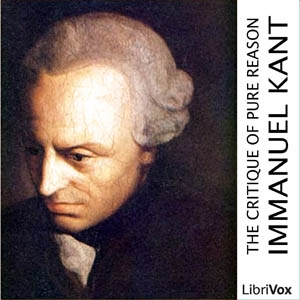
Critique of Pure Reason
The Critique of Pure Reason, first published in 1781 with a second edition in 1787, has been called the most influential and important philosophical text of the modern age.
Kant saw the Critique of Pure Reason as an attempt to bridge the gap between rationalism (there are significant ways in which our concepts and knowledge are gained independently of sense experience) and empiricism (sense experience is the ultimate source of all our concepts and knowledge) and, in particular, to counter the radical empiricism of David Hume (our beliefs are purely the result of accumulated habits, developed in response to accumulated sense experiences). Using the methods of science, Kant demonstrates that though each mind may, indeed, create its own universe, those universes are guided by certain common laws, which are rationally discernable. (Summary by Ticktockman)
Audiolibros
48 capítulos
26 h 9 min
- 1 Preface to the First Edition, 178120:04
- 2 Preface to the Second Edition, 178753:26
- 3 Introduction40:45
- 4 Transcendental Doctrine of Elements--Space20:21
- 5 Transcendental Doctrine of Elements--Time37:25
- 6 Transcendental Logic26:14
- 7 Transcendental Analytic23:33
- 8 Deduction of the Pure Conceptions17:20
- 9 Transcendental Deduction of the Pure Conceptions32:34
- 10 Application of the Categories to Objects of the Senses48:46
- 11 Analytic of Principles/Schematism45:14
- 12 System of All Principles of the Pure Understanding15:11
- 13 Systematic Representation of All Synthetical Principles/1st Analogy1:24:59
- 14 Second Analogy36:48
- 15 Third Analogy14:47
- 16 The Postulates of Empirical Thought43:08
- 17 Division of All Objects into Phenomena and Noumena34:55
- 18 Of the Equivocal Nature of Amphiboly12:25
- 19 Remark on the Amphiboly of the Conceptions of Reflections55:51
- 20 Transcendental Dialectic: Introduction9:07
- 21 Of the Conceptions of Pure Reason1:14:18
- 22 Of the Dialectical Procedure of Pure Reason4:49
- 23 Of the Paralogisms of Pure Reason49:08
- 24 The Antinomy of Pure Reason26:52
- 25 Antithetic of Pure Reason/1st & 2nd Conflicts38:56
- 26 3rd & 4th Conflict of the Transcendental Ideas29:49
- 27 Of the Interest of Reason in these Self-Contradictions27:35
- 28 Of the Necessity Imposed upon Pure Reason of Presenting a Solution of its Transcendental Problems40:09
- 29 Critical Solution of the Cosmological Problem35:03
- 30 Empirical Use of the Regulative Principle of Reason with regard to the Cosmological Ideas32:20
- 31 Solution of the Cosmological Idea of the Totality of the Deduction of Cosmical Events from their Causes51:16
- 32 Solution of the Cosmological Idea of the Totality of the Dependence of Phenomenal Existences15:24
- 33 The Ideal of Pure Reason26:29
- 34 Of the Arguments Employed by Speculative Reason in Proof of the Existence of a Supreme Being28:55
- 35 Of the Impossibility of a Cosmological Proof of the Existence of God26:53
- 36 Of the Impossibility of a Physico-Theological Proof34:04
- 37 Of the Regulative Employment of the Ideas of Pure Reason1:06:38
- 38 Of the Ultimate End of the Natural Dialectic of Human Reason51:33
- 39 Transcendental Doctrine of Method3:06
- 40 Discipline of Pure Reason in the Sphere of Dogmatism42:22
- 41 Discipline of Pure Reason in Polemics50:46
- 42 Discipline of Pure Reason in Hypothesis20:45
- 43 Discipline of Pure Reason in Relation to Proofs20:33
- 44 The Canon of Pure Reason14:37
- 45 Ideal of the Summum Bonum as a Determining Ground of the Ultimate End of Pure Reason24:53
- 46 Of Opinion, Knowledge, and Belief19:10
- 47 The Architectonic of Pure Reason30:13
- 48 The History of Pure Reason9:52