Essay Concerning Humane UnderstandingJohn Locke
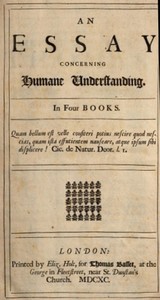
Essay Concerning Humane Understanding
John Locke's essays on human understanding answers the question “What gives rise to ideas in our minds?”. In the first book Locke refutes the notion of innate ideas and argues against a number of propositions that rationalists offer as universally accepted truth. In the second book Locke elaborates the role played by sensation, reflection, perception and retention in giving rise to simple ideas. Then he elaborates on how different modes, substances and relations of simple ideas (of the same kind) give rise to complex ideas v.g. space, time, infinity etc. Finally he discusses complex ideas of mixed modes which arise from a combination of simple ideas of different kinds v.g. identity and diversity, cause and effect, etc. (Summary by bala)
Prooflistening for this project was done by bala and Rapunzelina
Audiolibros
41 capítulos
17 h 23 min
- 1 Introduction.14:38
- 2 No innate speculative principles. Part I28:34
- 3 No innate speculative principles. Part II29:13
- 4 No innate practical principles. Part I35:18
- 5 No innate practical principles. Part II31:02
- 6 Other considerations concerning innate principles, both speculative and practical. Part I30:59
- 7 Other considerations concerning innate principles, both speculative and practical. Part II30:58
- 8 Of ideas in general, and their original. Part I22:55
- 9 Of ideas in general, and their original. Part II22:02
- 10 Of simple ideas ; of simple ideas of sense ; idea of solidity.26:09
- 11 Of simple ideas of divers senses ; Of simple ideas of reflection; Of simple ideas of both sensation and reflection.16:17
- 12 Some further considerations concerning our simple ideas of sensation35:48
- 13 Of perception22:09
- 14 Of retention15:52
- 15 Of discerning, and other operations of the mind24:44
- 16 Of complex ideas7:58
- 17 Of simple modes:—and first, of the simple modes of the idea of space Part I25:04
- 18 Of simple modes:—and first, of the simple modes of the idea of space Part II23:38
- 19 Idea of duration and its simple modes Part I17:24
- 20 Idea of duration and its simple modes Part II17:07
- 21 Ideas of duration and expansion, considered together17:45
- 22 Idea of number and its simple modes14:12
- 23 Of the idea of infinity Part I22:01
- 24 Of the idea of infinity Part II20:15
- 25 Of other simple modes; of the modes of thinking ; of modes of pleasure and pain32:01
- 26 Of the idea of power Part I32:24
- 27 Of the idea of power Part II32:23
- 28 Of the idea of power Part III34:10
- 29 Of the idea of power Part IV32:58
- 30 Of mixed modes20:33
- 31 Of our complex ideas of substances Part I30:13
- 32 Of our complex ideas of substances Part II30:41
- 33 Of collective ideas of substances; of ideas of relation; of ideas of cause and effect, and other relations27:13
- 34 Of ideas of identity and diversity Part I23:39
- 35 Of ideas of identity and diversity Part II25:58
- 36 Of ideas of other relations37:55
- 37 Of clear and obscure, distinct and confused ideas33:30
- 38 Of real and fantastical ideas6:59
- 39 Of adequate and inadequate ideas33:11
- 40 Of true and false ideas37:32
- 41 Of the association of ideas20:14
